
Could I Be Hooked on My Wearable Device?

An atmosphere of feeling of anticipation. Visible is the chilled vapour emanating from my fellow runners as they execute the "pre-race" shuffle on the beginning point.
A swift twitch of the hips.
I'm at my local weekly parkrun event and I'm focused. It's almost time...
Hold on. I need to start my tracker. The same goes for the guy beside me.
The person waiting expresses impatience. I'm not moving until… yes! GPS ready, and I'm running.
In the mele, it's hard to find a person without a wearable on it. And this isn't only us athletes who wear them.
This is a booming, multi-billion pound sector. Names like Samsung Galaxy are prevalent, featuring an broad array of various models to suit a range of lifestyles. According to how high tech the watch you go for, costs can vary between a hundred pounds to thousands of pounds.
"It drives me insane, it's impossible to switch off."
"It comforts me… It feels like a supporter supporting me."
"I wish it wouldn't say I've experienced a bad night's sleep."
A small sample of the responses I've received from other device users when I question what they think of theirs.
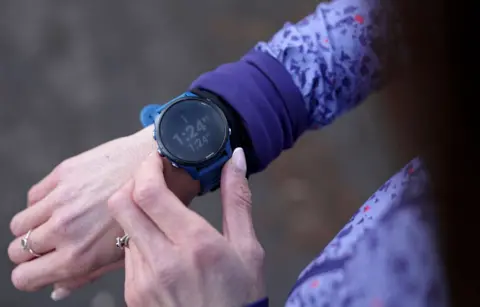
The Data Dilemma
My current opinion on my own device? Currently, annoying. It's telling me I'm not hitting my target, causing me to question whether the foliage I'm passing under are disrupting my location tracking.
Countless individuals of us fasten these little monitors onto our arms and wear them 24/7, apparently at ease with the fact they're continuously monitoring us.
Gone are the days when we used them only to give us an estimation of our daily steps. Now, they can measure our sleep quality, stress levels, glucose levels, our body battery.
It's difficult to find a health indicator they aren't designed to measure.
But are they able to do what they claim to do? And are the statistics we obsess over a faithful picture of the truth? Do they boost our overall health, or do the plethora of metrics and cheerleading alerts just add to our daily stresses?

A Complicated Bond
"I become a quite fixated with mine," a wearer reveals.
While she loves how her device tracks her workouts, she finds some of its other features "daunting" at times - a feeling that became apparent during a major life event.
Prior to discovering she could adjust the settings, her smartwatch constantly alerted her she was not being productive enough. Later on, the watch insists her she's had a bad night's sleep.
"I am caring for a six-month old, I don't need to be informed I've not slept," she says. "I know that only too well."
Why doesn't she just take it off?
"I could, I suppose, but I have this complicated dynamic with it," she explains. "I value it for its exercise data, I just wonder whether the myriad other functions it can now do is perhaps overkill for me."
How Do They Work?
Each model of smartwatch has its own unique way of tracking your bodily functions and analysing your data, but the vast bulk use detectors on the underside of the watch.
They usually shine small, green LED lights onto your wrist which can observe pulsation, detecting your heartbeat. More advanced devices measure changes in the electrical current that runs through the skin to assess your nervous system activity.
A Fine Balance
A data scientist says that in general for smartwatches, it's a "difficult line" - while the ever-evolving tech could realistically prevent illness, "detecting disease before we show symptoms", it could also turn us the tracked into the "worried well".
He points out that the most advanced wearables can perform tests like electrocardiograms (ECGs), which continuously monitor how stable the heart is. They can flag if someone is experiencing atrial fibrillation (AF), where there is abnormal impulses in the heart causing an irregular heartbeat.
This does not automatically signal someone is on the verge of a heart attack, but it can give an early warning they might be more at risk of a stroke in the long term.
But how to make sense of these numbers is complex. The expert concerns that as more functions are added, people may struggle to fully contextualise their data.
"I remain sceptical that the ability to monitor so much data is such a beneficial thing," he says.
A professor focusing on wearable tech echoes this sentiment. Research into the effect of wearable tech on a specific group of individuals with health issues suggested a noticeable percentage of those who were given devices to monitor their heart health experienced heightened worry and were "far more likely to use healthcare resources".
She noted a vicious circle with her patients - they saw a alarming metric on their watch. They felt anxious. Their pulse rose. They got even more concerned. They checked again, and their heart rate went up again.
"When people are presented with numbers about ourselves that we can't properly interpret then, naturally, we are going to seek clarification," the psychologist says. "We monitor, we re-check - it becomes a vicious cycle."